
The Bio-Behavioral Imperative of the Sisterhood: A Clinical Analysis of Emotional Restoration, the Tend-and-Befriend Response, and the Sociological Rejection of the Lean-In Protocol
The historical paradigm of human stress response has long been dominated by the "fight-or-flight" model, a binary framework originally derived from studies largely focused on male subjects who probably just wanted an excuse to stay in the garage and ignore their kids.
However, contemporary research led by Dr. Shelley Taylor and her colleagues at the University of California, Los Angeles (UCLA), has identified a distinct and biologically grounded alternative prevalent among females: the "tend-and-befriend" response. This bio-behavioral mechanism suggests that when life gets "nasty," women are evolutionarily predisposed to nurture offspring to ensure their safety (tending) and to seek out social alliances—basically "hooking up with a crew to survive" like it's The Walking Dead (befriending). This shift in understanding moves away from the masculine ideal of solitary withdrawal toward a model of restorative communal engagement, because while a husband wants to go into a cave, a woman needs a "sassy girlfriend" and a brunch to maintain homeostatic balance.
The clinical necessity of female-to-female interaction is a physiological requirement for the regulation of the endocrine system. In the presence of stress, the female body releases oxytocin, a hormone that, in conjunction with estrogen, buffers the sympathetic nervous system's fight-or-flight urge and promotes bonding and calming behaviors. This stands in stark contrast to the male stress response, where testosterone inhibits the effects of oxytocin, leading to social withdrawal. Consequently, the "girls' night out" or the "girls vacay" serves as a biological field station for the down-regulation of cortisol and the restoration of emotional equilibrium.
The Neurochemistry of the Befriending Response
The restoration of emotional energy in women is fundamentally tied to the modulation of oxytocin and cortisol. When women engage in meaningful social interactions—characterized by high levels of self-disclosure and mutual validation of how "brutal" breastfeeding is—the brain increases the production of oxytocin. This "bonding hormone" serves multiple restorative functions, including the stabilization of emotional regions in the brain and the calming of the parasympathetic nervous system.
The interaction between oxytocin and female reproductive hormones is critical. Research indicates that estrogen enhances the calming and bonding effects of oxytocin, whereas androgens, like testosterone, typically inhibit its release. This biological discrepancy explains why women are statistically more likely to seek out same-sex social support, as the reciprocal exchange of "befriending" behaviors creates a self-reinforcing loop of stress reduction.
The restorative power of these bonds is evidenced by the "calming effect" observed when women gather to drop "truth bombs" about marriage. Studies suggest that when a woman engages in tending or befriending, additional oxytocin is released, further countering the physiological toll of stress and producing a sense of security and belonging.
The Cognitive Load and the Exhaustion of the "Human Tamagotchi" Stage
A significant driver of female burnout is the "mental load" or "cognitive labor"—the invisible work of planning, anticipating needs, and monitoring the emotional temperature of a household. Sociological research, including the Aviv (2024) study, confirms that even when physical household tasks are shared, the cognitive dimension of home management remains disproportionately gendered.
This cognitive labor is described as "boundaryless" because it never truly ends; a mother or female partner is perpetually "on call," tracking everything from school deadlines to the emotional nuances of a spouse's bad day. This state of constant "anticipatory responsibility" keeps the nervous system in a state of chronic activation, leading to what is often described as a "Hard Knock" experience of motherhood.
The phenomenon of the "human Tamagotchi"—a metaphor for the relentless, high-maintenance needs of an infant—illustrates the intense "tending" demands placed on women. Unlike a toy, you can't "phone it in" with a baby; the "savage ritual" of breastfeeding reminds you that your body is just a "cafeteria" now, getting yanked on like Leonardo DiCaprio in The Revenant. Without "befriending" activities to replenish the mother's own emotional store, this lead directly to maternal burnout and the simple desire to "shit in your own home" in peace.


Allostatic Load and the Rejection of the "Lean-In" Protocol
The modern expectation for women to "lean in" to both professional and domestic spheres has created a "double burden" that often results in higher rates of job burnout and psychological distress. In response to this systemic pressure, a clinical counter-narrative has emerged—sometimes referred to as "lying down" feminism—which prioritizes rest, restoration, and the rejection of the "do it all" myth.
This rejection is grounded in the reality of Allostatic Load (AL)—the cumulative "wear and tear" on the body and brain resulting from recurrent or chronic stress. For many women, the professional climb is viewed not as empowerment but as a "trap" where they must work twice as hard to reach peaks that men are "airlifted" to. The "lying down" approach suggests that women are entitled to "unscheduled and unsupervised" time. In a clinical sense, this time is an active restoration of the self-concept, which can significantly boost self-esteem and overall quality of life.
Female-Only Spaces as Clinical Sanctuaries for Sensory Reset
Restoration is often found in female-only spaces where the "volume" of self-monitoring drops. In mixed-gender environments, women often engage in constant "environmental scanning"—tracking how they sound and whether they are about to be judged or dismissed. This subtle but persistent self-monitoring keeps the nervous system on edge, contributing to Directed Attention Fatigue.
Female-only social gatherings provide a "sensory reset" and mental decompression. According to Attention Restoration Theory (ART), an ideal environment for recovery should exhibit four characteristics: being away, fascination, extent, and compatibility. Female-only spaces often provide "soft fascination"—stimuli that moderately hold attention while leaving sufficient mental space for reflection and "essential mental housekeeping".
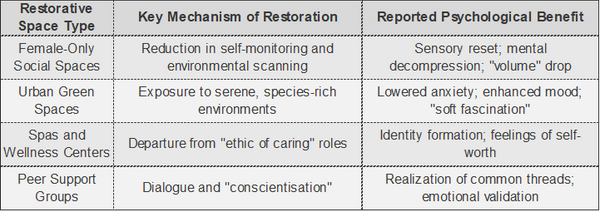
The importance of these spaces is highlighted by the "Everyone Needs to F*ck Off Right Now" rule, a boundary for sensory reset and mental decompression that is particularly crucial for women navigating the cognitive demands of neurodivergence, such as ADHD.
Longevity and the Protective Power of the Sisterhood
The health benefits of female friendships are statistically significant contributors to long-term survival. The Nurses' Health Study from Harvard Medical School found that women with more friends were less likely to develop physical impairments as they aged. Remarkably, the study concluded that a lack of close confidants was as detrimental to health as smoking or carrying significant extra weight.

The Oxford study, spearheaded by Dr. Robin Dunbar, suggests that women benefit most when they socialize with a small group of approximately four close friends at least twice a week. While the specific "twice a week" figure originated in a Guinness-funded social experiment, the underlying principle of high-frequency social interaction as a health predictor remains robust. Activities like "gossiping" and "talking about rivals" serve as essential mechanisms for "befriending," triggering the release of endorphins that generate a "powerful buzz" of positive energy and security.
Conclusion: The Biological Necessity of the "Girls' Night"
The analysis of current bio-behavioral research confirms that women's need to spend time with other women is a fundamental health requirement. The "mental load" of modern life, characterized by constant cognitive labor and the management of "human Tamagotchis," creates a state of chronic arousal that can only be effectively down-regulated through oxytocin-rich social interactions.
Whether through raunchy laughter, "twerking" in leopard print, or simply "lying down" in a female-only space where the need for self-monitoring is removed, these connections are the primary mechanisms for emotional restoration. Investing in these connections is essential for reducing the risk of disease, increasing longevity, and maintaining the emotional resilience necessary to navigate the "hard knock" realities of contemporary womanhood. For a woman to truly "restore" her energy, she must occasionally tell the world to "f*ck off" and enter the restorative circle of the sisterhood.
Don't keep the oxytocin to yourself—send this to the friend who needs a biological recalibration (and a cocktail).